The two major ports in the United States and West remained stable in February. Global supply chains are facing more uncertainty.
According to Shipping Industry Network, container cargo volume at the two major West Coast ports, Los Angeles (LA) and Long Beach (LB), remained stable in February.
Specifically, in February, container throughput at the Port of Los Angeles reached 824,000 TEU, a year-on-year increase of 3.0%. Among them, imports of loaded containers at the Port of Los Angeles increased by 5.0% year-on-year to 434,000 TEU, while exports of loaded containers grew by 6.8% to 117,000 TEU. Additionally, the number of empty containers passing through the Port of Los Angeles decreased by 1.8% year-on-year to 274,000 TEU.
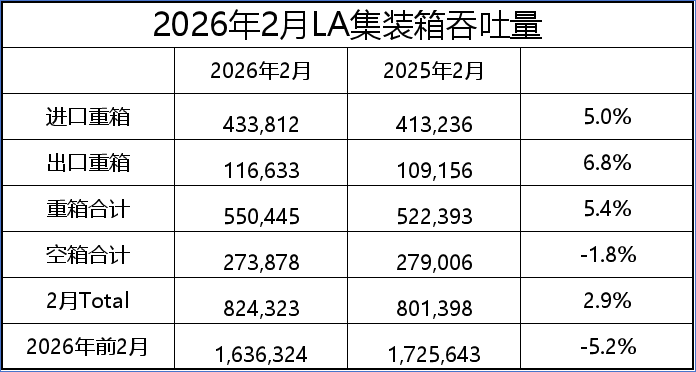
In the first two months of 2026, container cargo volume at the Port of Los Angeles reached 1.636 million TEU, a year-on-year decrease of 5.2%.
Gene Seroka, Executive Director of the Port of Los Angeles, stated during the monthly media briefing that although cargo volume remains stable, global developments are bringing uncertainty to the entire supply chain.
Gene Seroka pointed out, “With so many developments impacting the supply chain, from Middle East conflicts to Supreme Court tariff rulings and broader shifts in trade policy, the entire industry is indeed facing uncertainty at the moment.”
He emphasized, “Even so, the flow of goods serving U.S. manufacturing continues, and so far, there has been no disruption to goods destined for the United States.”
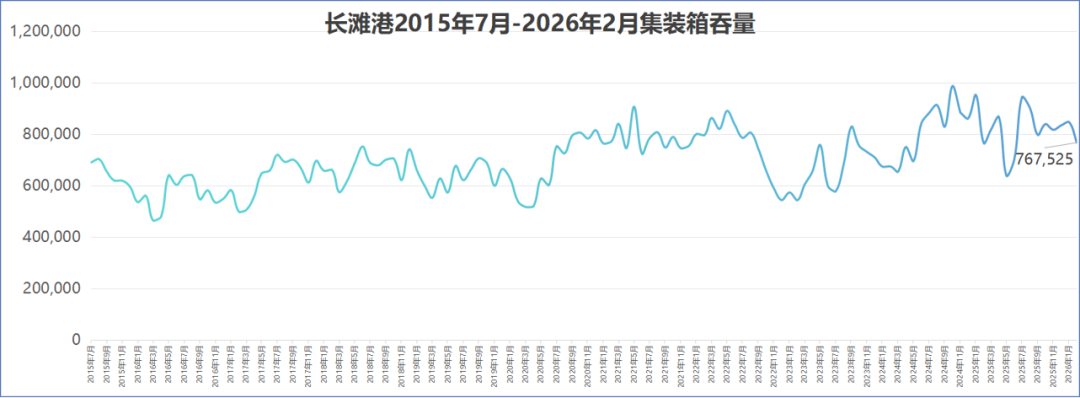
Container throughput at the Port of Long Beach reached 768,000 TEU in February
On March 18, the Port of Long Beach announced that container throughput in February reached 768,000 TEU, a year-on-year increase of 0.3%.
Specifically, container throughput at the Port of Long Beach reached 768,000 TEU in February, a year-on-year increase of 0.3%. Among them, imports of loaded containers decreased by 0.2% year-on-year to 368,000 TEU, while exports of loaded containers grew by 8.2% to 97,000 TEU. Additionally, the number of empty containers passing through the Port of Long Beach decreased by 1.5% year-on-year to 302,000 TEU.

In the first two months of 2026, the Port of Long Beach handled 1.615 million TEU, a year-on-year decrease of 6%.
The Port of Long Beach stated that amidst ongoing uncertainty caused by tariffs and Middle East turmoil, the port reported stable cargo volume in February.
Dr. Noel Hacegaba, Chief Executive Officer of the Port of Long Beach, stated, “Cargo volume at the Port of Long Beach maintained positive growth in February.”
He pointed out, “Despite increasing uncertainty caused by escalating Middle East conflicts, goods continue to flow smoothly, planned shipments are proceeding on schedule, and the Port of Long Beach remains a safe harbor amidst trade and geopolitical uncertainty.”
The Chief Executive Officer of the Port of Long Beach stated that the port is closely monitoring developments in the Middle East and the impact of the U.S. Supreme Court’s ruling on tariffs under the International Emergency Economic Powers Act (IEEPA).
He stated, “Middle East conflicts have added more uncertainty to global trade and triggered widespread market conditions and reactions from various supply chain stakeholders.”
He pointed out, “The closure of the Strait of Hormuz has already led to a rapid increase in oil prices.”
“When oil prices rise, transportation costs also increase, and consumers spend more at gas stations and on many everyday goods.”
However, he noted that the global supply chain is interconnected. “If the conflict persists and continues to escalate, supply chains worldwide will have to cope with higher fuel and shipping operation costs and seek alternative routes.”
Frank Colonna, Chairman of the Long Beach Port Commission, stated, “The Port of Long Beach remains a strategically significant seaport in the global market and a reliable choice for customers.”
-
China has established a new channel in the southwestern region connecting inland areas to the sea.3159
-
China Merchants Group's intelligent ships make new moves.4493
-
The 9th International Diving and Offshore Exhibition Opens in Qingdao This November4929
-
The nation's first emergency drill for a biofuel spill was held at Tangshan's Jingtang Port.3430
-
Trillion-dollar market accelerating into shape! What can an "energy island" change?3643