China has established a new channel in the southwestern region connecting inland areas to the sea.
In a prosperous era, a canal is built, opening a new path through Pinglu. At 10:25 a.m. on September 16, with the long whistle of the first voyage ship at the Madao Hub in Qinzhou, Guangxi, the Pinglu Canal, the first canal project coordinated at the national level since the founding of New China, officially opened to navigation. As a key project of the New Western Land-Sea Corridor and a landmark project in accelerating the construction of a transportation powerhouse, the Pinglu Canal has established the shortest waterway from Southwest China to ASEAN.
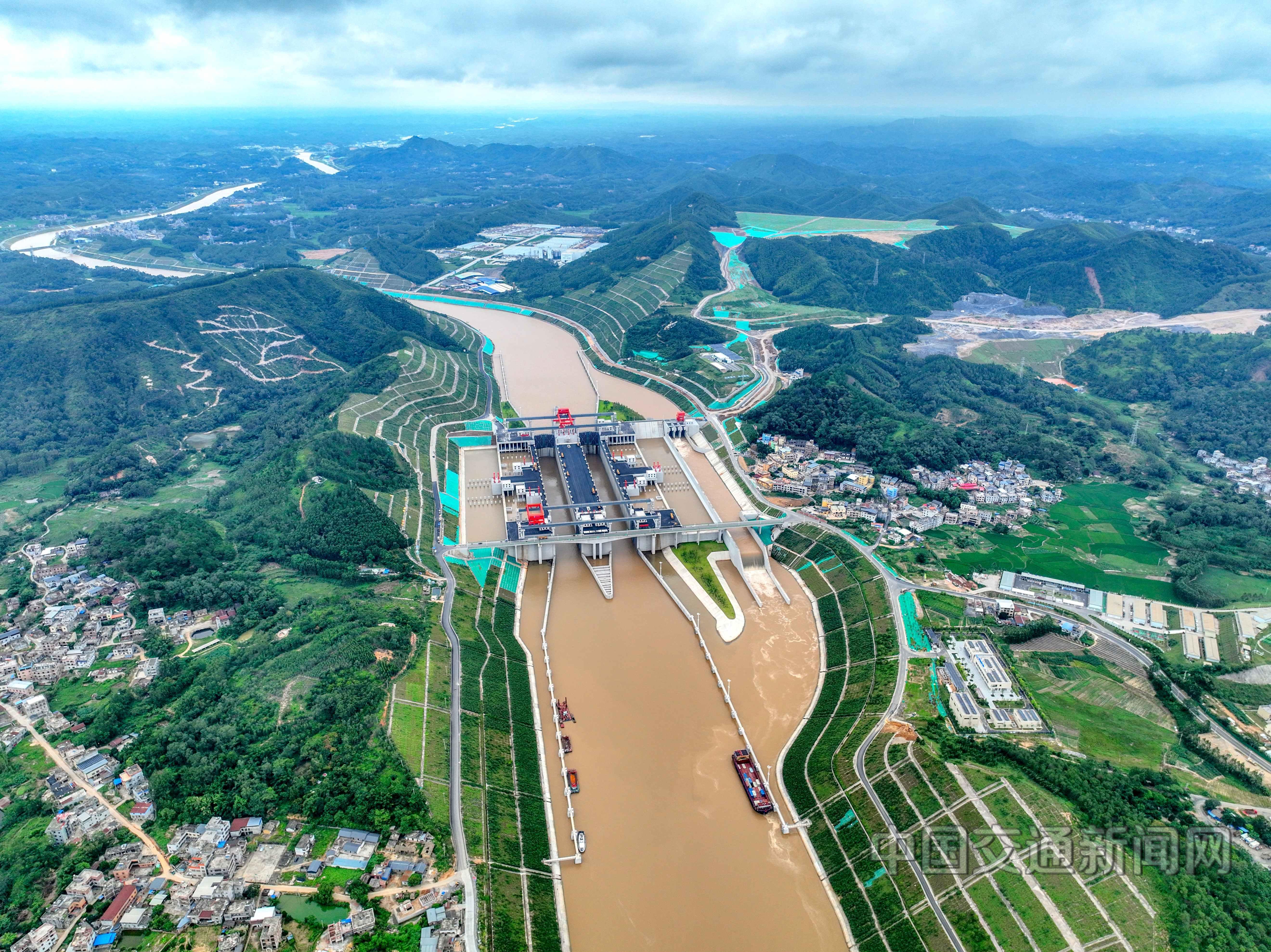
From the Pingtang River Estuary in Hengzhou, Nanning, to the Beibu Gulf International Hub Seaport, this 134.2-kilometer-long canal is built to inland waterway Class I standards, capable of accommodating 5,000-ton ships. It is the highest-grade navigable canal in the country, ending Guangxi's history of "being near the sea but without rivers flowing into it."
The canal has a total water level drop of 65 meters, with the construction of three major tiered hubs: Madao, Qishi, and Qingnian, allowing ships to "climb stairs" step by step. Its "value" lies in being safe, water-saving, and time-efficient.
The Madao and Qishi hubs adopt a world-first three-tier water-saving pool stacked layout, achieving a water-saving rate of over 60%. The three hubs save more than 1 billion cubic meters of water annually, equivalent to the storage capacity of about 70 West Lakes. Gradual water discharge means reduced lock passage efficiency. The canal team pioneered the "maze-like buffer sleeve" hydraulic opening and closing technology, enabling the working valves at the Madao and Qishi hubs to operate at "China speed," with doors opening in just 1 minute and closing in only 30 seconds.
With an investment of 72.7 billion yuan, 315 million cubic meters of earth and rock excavated, and 27 main bridges across the canal constructed, over 20,000 builders have worked tirelessly since construction began in August 2022. They have achieved one world-first and four world records, striving to create a high-quality, green, and clean project. "The Pinglu Canal showcases to the world the self-reliant and self-strengthening engineering miracle of China and the confidence of a great nation," said Yuan Heping, an engineer involved in the planning and construction of the Pinglu Canal project.
While the majestic canal flows through mountains, rivers, and seas, an invisible "digital canal" is simultaneously growing in the cloud. The Pinglu Canal is the first smart canal in China with a full lifecycle, equipped with a monitoring system based on BeiDou, cloud computing, and artificial intelligence, achieving comprehensive visualization, intelligent control, and one-click access.
With green as its foundation, this century project coexists harmoniously with nature. Photovoltaic systems are built alongside ship locks, generating 4.457 million kilowatt-hours of electricity annually and reducing carbon dioxide emissions by 2,297 tons each year. A three-dimensional ecological system includes fish passages underwater, purification in the water, green corridors on the banks, and bird pathways in the air, reflecting the modern canal's goodwill toward nature and responsibility for the future.
Simultaneously with the opening of navigation, the canal's operational rules and support systems were implemented. The "Pinglu Canal Protection and Management Regulations" were introduced, clearly defining the protection of the canal's waterways, navigation management, ecological protection, and the responsibilities of all parties in legal terms. The Guangxi Integrated Smart Dispatching Platform for Waterway, River, and Sea Transportation was launched for trial operation, enabling the "smart canal" to achieve one-time cargo declaration and seamless navigation. The "Pinglu Canal Navigation Safety Management Regulations" innovatively integrate inland and maritime navigation standards, making the river and sea "connected by one water" across a single bridge.
According to relevant officials from the Guangxi Zhuang Autonomous Region Department of Transportation, with the opening of the canal, the Southwest region now has two sea routes: the Pinglu Canal and the Xijiang Shipping Trunk Line, forming a "vertical and horizontal" network. The vertical sea route reduces the distance to the sea by about 560 kilometers compared to the horizontal route, potentially saving over 5 billion yuan in transportation costs annually. The intermodal system of river, rail, and sea centered on the Pinglu Canal is becoming a key pivot for reducing costs, improving quality, and enhancing efficiency in the New Western Land-Sea Corridor.
On the day of navigation, the "Nanning-Vietnam Can Tho" foreign trade route and the "Nanning-Hainan Yangpu" domestic trade route were launched in both directions, along with the simultaneous opening of four water passenger transport routes. A single canal is connecting the "vitality of the river" with the "power of the sea," propelling the vast inland hinterland of the West toward the forefront of opening up to the outside world.
-
China has established a new channel in the southwestern region connecting inland areas to the sea.3159
-
China Merchants Group's intelligent ships make new moves.4493
-
The 9th International Diving and Offshore Exhibition Opens in Qingdao This November4929
-
The nation's first emergency drill for a biofuel spill was held at Tangshan's Jingtang Port.3432
-
Trillion-dollar market accelerating into shape! What can an "energy island" change?3645