"‘Jin Hai Fa Tong’ Real-Scene Mobile Arbitration Court Iteratively Upgraded: Tianjin Maritime 'One-Stop' Dispute Resolution Center (Newport Station) Officially Launched!"
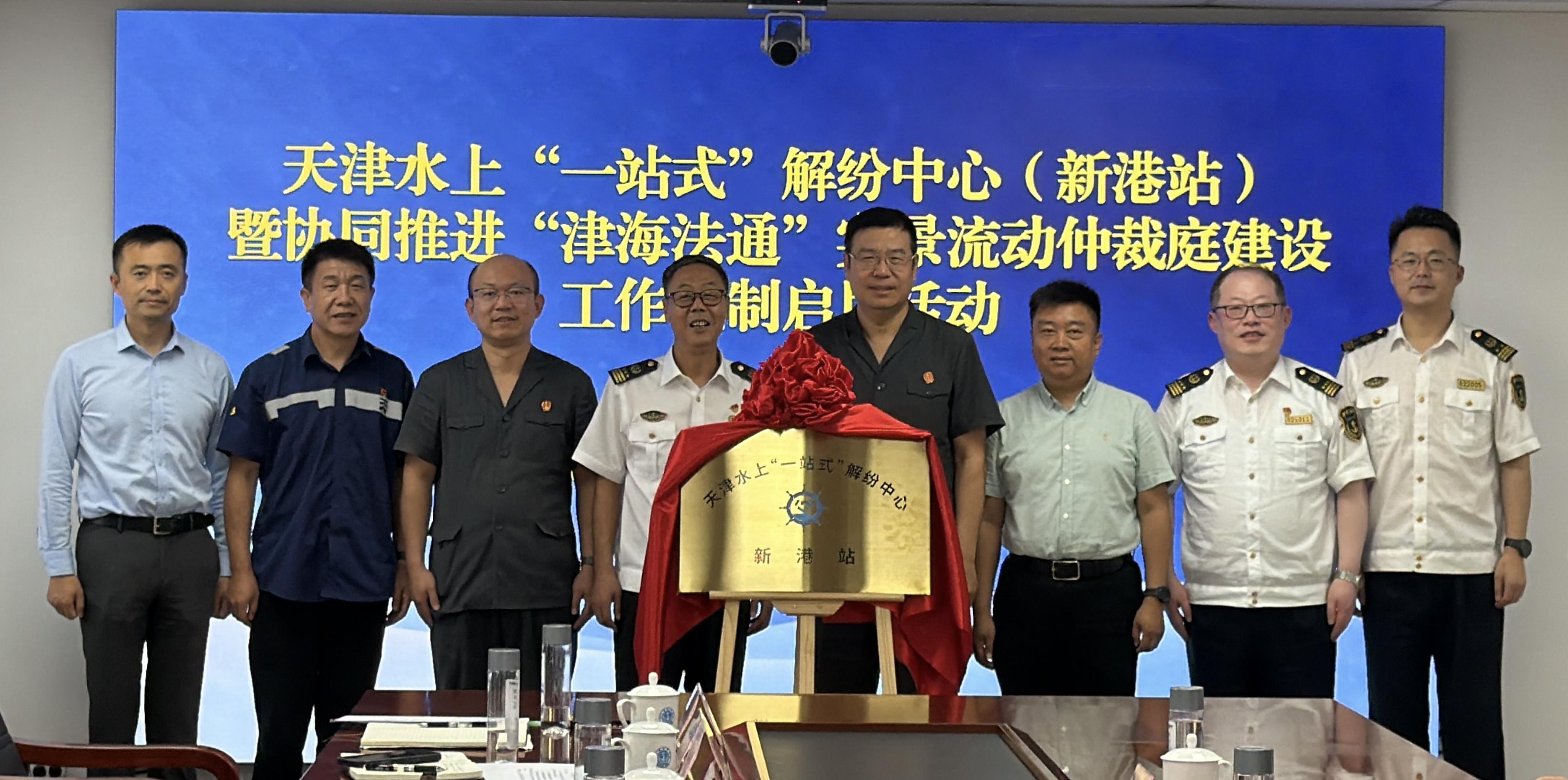
On September 17, the Tianjin Waterborne "One-Stop" Dispute Resolution Center (Xingang Station) officially began operations, and a collaborative meeting to promote the construction of the "Jinhai Law Connect" real-time mobile arbitration court was held simultaneously. Representatives from Tianjin Maritime Safety Administration, Tianjin Arbitration Commission, Tianjin Maritime Court, Tianjin Lawyers Association, and Tianjin Port Tugboat Co., Ltd. participated in the event. This station is another key addition to Tianjin's waterborne "One-Stop" dispute resolution platform, following the Dagukou Station and Offshore Workstation. It systematically consolidates the operational experience of the "Jinhai Law Connect" mobile arbitration court, upgrading from the previous maritime-arbitration dual collaboration model to a multi-party co-construction and integrated operation of a tangible legal platform involving maritime, arbitration, and judiciary. It also synchronizes with the Seafarer Service Station to provide efficient, low-cost maritime dispute resolution and convenient services at the doorstep of port and shipping enterprises and seafarers.
Nation's First Mobile Arbitration Court at Maritime Institution Delivers Outstanding Results
A year ago, the nation's first mobile arbitration court stationed at a maritime management institution—the "Jinhai Law Connect" mobile arbitration court—was established and began operations at the Tianjin Xingang Maritime Safety Administration. The Tianjin Maritime Safety Administration, in collaboration with the Tianjin Arbitration Commission, innovatively created a "administrative mediation + professional arbitration" integrated model, implementing a dual-track approach of "pre-mediation for accident-related cases and direct arbitration for non-accident cases." This brought arbitration services directly to the frontlines of law enforcement, addressing the pain points of traditional maritime disputes such as "multiple trips, lengthy rights protection, and difficulty in enforcement."
Since its operation, the platform has achieved two landmark breakthroughs:
First, Tianjin's first maritime mediation-to-arbitration case confirming seafarers' livelihood issues. In a dispute over medical expenses due to a seafarer's sudden illness onboard, the arbitration confirmation was submitted within one hour after signing the mediation agreement, and the entire process was completed in just three days. The rights protection cycle was shortened by 75% compared to conventional paths, and arbitration fees were waived, genuinely safeguarding the rights of seafarers.
Second, Tianjin's first maritime ad hoc arbitration case after the implementation of the newly revised "Arbitration Law of the People's Republic of China." The case involved the proper handling of a foreign personal injury compensation dispute concerning inspection personnel aboard a Liberian-flagged vessel. It adhered to international maritime dispute resolution practices, filled the local gap in maritime ad hoc arbitration, and served the needs of resolving foreign-related disputes in the northern international shipping hub.
At the same time, the Seafarer Service Station has been actively enhancing its efforts, creating a comprehensive service platform for seafarers that integrates party leadership, safety education, legal consultation, and convenience services. This promotes the prevention of risks at the source and forms a complementary structure with the mobile arbitration court for "front-end prevention and mid-end resolution."
Embarking on a New Journey of Diversified Dispute Resolution Construction
The official launch of the Tianjin Waterborne "One-Stop" Dispute Resolution Center (Xingang Station) is not merely about adding a new location but represents an integrated upgrade and expansion. The station brings together maritime administration, judiciary, arbitration, and legal services, connecting the entire chain of administrative mediation, arbitration confirmation, judicial confirmation, and enforcement. It transforms from a single mediation platform into a comprehensive waterborne dispute resolution hub.
Dual-track empowerment equips mediation agreements with a "legal effectiveness engine." An innovative "one mediation, dual confirmation" mechanism has been implemented. After reaching an agreement through administrative mediation, parties can independently choose between arbitration confirmation or judicial confirmation, both of which result in legally enforceable documents, effectively solving the issue of "easy mediation but difficult enforcement." If mediation fails, disputes are directly redirected to arbitration or litigation channels, fully respecting the parties' procedural choices.
Physical platform + mobile services achieve "one-stop" dispute resolution. The "Jinhai Law Connect" mobile arbitration court is equipped with a joint mediation room and a digital arbitration court. Arbitrators and arbitration secretaries are stationed regularly to provide services, maritime professional lawyers offer free legal consultations, and a green channel for judicial confirmation is opened. Service resources are also extended to docks, accommodating foreign vessels during berthing windows and enabling remote case handling for parties in different locations. Online and offline services are integrated to allow for on-site acceptance, mediation, and arbitration.
Protecting seafarers' rights, opening a "public welfare green channel." By linking with the front-end touchpoints of the Seafarer Service Station, the focus is on safeguarding the legitimate rights of seafarers. Public welfare rights protection channels are opened for disputes related to seafarers' labor, services, and maritime personal injuries. Arbitration service fees are reduced or waived for eligible cases, lowering the economic burden of rights protection for seafarers and small and medium-sized shipping enterprises, and delivering warm-hearted services directly to the docks and ships.
Closed-loop arbitration linkage opens a "fast track" for the enforcement of effective documents. A convenient internal transfer channel for the enforcement of effective documents has been established. Mediation agreements, arbitration awards, and judicial confirmation rulings are centrally collected and transferred by the dispute resolution center, eliminating the need for parties to submit materials repeatedly and fundamentally enhancing the credibility of non-litigation dispute resolution.
Expert think tank support provides a "brain trust" for complex cases. A composite maritime expert think tank has been established, incorporating maritime investigators, judges, arbitrators, senior captains, and maritime lawyers. The think tank conducts joint consultations and mediations for foreign-related, high-value, and complex group cases. Regular joint training and case reviews are conducted to unify maritime legal applications and mediation standards.
Next, the Tianjin Maritime Safety Administration will lead all co-construction units in firmly holding the "baton" of dispute resolution. It will take the substantive resolution of conflicts, reduction of rights protection costs, and safeguarding of public rights as the "touchstone" for evaluating work quality. The administration will continue to improve the diversified waterborne dispute resolution system, enhance the "Jinhai Law Connect" brand, and provide solid legal guarantees for the construction of a strong transportation nation and the Tianjin Northern International Shipping Hub.
-
"‘Jin Hai Fa Tong’ Real-Scene Mobile Arbitration Court Iteratively Upgraded: Tianjin Maritime 'One-Stop' Dispute Resolution Center (Newport Station) Officially Launched!"3132
-
China has established a new channel in the southwestern region connecting inland areas to the sea.3170
-
China Merchants Group's intelligent ships make new moves.4501
-
The 9th International Diving and Offshore Exhibition Opens in Qingdao This November4943
-
The nation's first emergency drill for a biofuel spill was held at Tangshan's Jingtang Port.3439