Power Supplied to All Three Major Locks of the Pinglu Canal; Canal Navigation Nears Inaugural Operation
```html
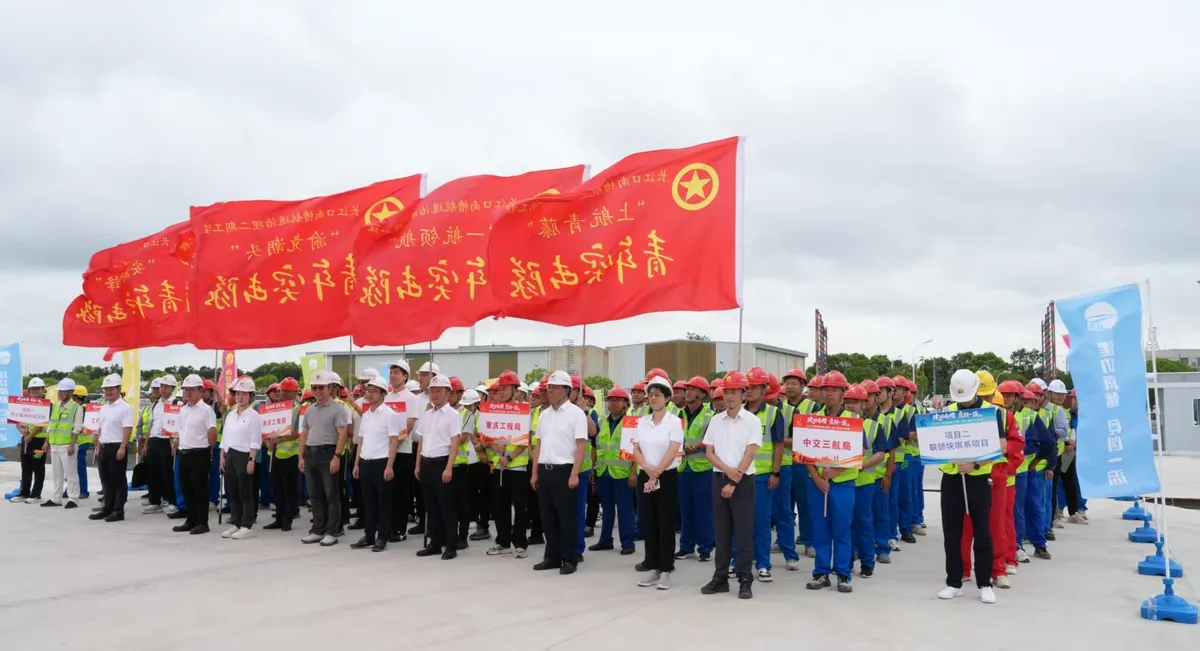
On March 20, the "Project of the Century" Pinglu Canal Qishi Hub successfully achieved its first phase of power transmission. With this, the three major hubs—Qingnian Hub, Madao Hub, and Qishi Hub—are all "powered and in place," officially entering a new phase of joint commissioning and testing of the ship lock equipment.
This is not an ordinary power transmission
On January 30, Qingnian Hub successfully transmitted power; on February 8, Madao Hub successfully transmitted power; on March 20, Qishi Hub successfully transmitted power...
The successive "powering up" of the three major hubs has provided the foundational conditions for the powered commissioning of core equipment such as the ship lock opening and closing system, monitoring and dispatching platform, and flood control and drainage facilities. The overall project will shift from "being built" to "being operational."
"We provide services ahead of demand, ensuring that the power transmission time for each hub is at least 10 days earlier than originally planned, making every effort to ensure power supply for the trial operation of navigation," said Huang Ruiyi, Manager of the Marketing Department at the Qinzhou Power Supply Bureau of China Southern Power Grid.
Faced with tighter timelines, faster pace, and higher requirements for canal construction, the Qinzhou Power Supply Bureau has fully reinforced its responsibility for power service, maintaining round-the-clock monitoring, comprehensive support, and all-around safeguarding. By precisely matching the commissioning window for ship lock equipment, the bureau has tailored a scientific and reasonable power supply plan for the project, simplified the electricity application process, and achieved rapid connection and power transmission. With the approach of "electricity waiting for the project," they are making every effort to ensure that the Pinglu Canal achieves its trial operation target on schedule.
Accelerating power transmission with responsibility and perseverance
To ensure the electricity needs for the construction of the Pinglu Canal, the Qinzhou Power Supply Bureau has implemented a "dual chief" service mechanism, where the bureau's leadership team acts as "Chief Customer Managers + Chief Problem-Solving Officers." They have also innovatively established a "Six-One" coordination mechanism to comprehensively advance various power service guarantee tasks. They promptly liaise with relevant departments and units involved in canal construction to proactively understand the power needs of hub construction projects and formal electricity requirements. It is reported that the bureau's dedicated service team has conducted over 30 on-site visits to discuss the power installation and connection for the three major hubs, effectively resolving multiple critical bottlenecks in power projects and improving power transmission efficiency.
Faced with tight schedules, complex terrain, and challenges in cross-regional coordination, the bureau adhered to the principles of "fast installation, fast connection, and fast transmission," breaking conventional processes and innovatively implementing a "segmental acceptance" model—"complete one segment, accept one segment, transmit power to one segment." This approach shifted from "waiting for overall completion" to "partial early operation." By establishing a "discovery—assignment—resolution—feedback" closed-loop mechanism, they efficiently resolved eight technical and coordination challenges, reducing the overall power transmission cycle by over 12%.
Ensuring the canal's journey to the sea with high-quality power
If major projects are the "ballast stones" of economic development, then power supply is the "vanguard" for project implementation. Since the construction of the Pinglu Canal began in 2022, the Qinzhou Power Supply Bureau has resolutely implemented the decisions and deployments of the higher-level party committee and government. They have planned and coordinated early, collaborated across multiple departments, and focused on three key tasks: relocating power facilities, providing electricity for construction projects (resettlement sites), and planning and building the power grid. They have taken responsibility and tackled challenges to provide robust power support throughout the construction of the Pinglu Canal and the development of the canal economic belt. As of now, the bureau has completed the relocation of 114 power lines and 261 power facilities, delivered power to 152 canal construction projects, and achieved a power transmission capacity of over 172.5 MVA, securing valuable time and space for the completion and navigation of the Pinglu Canal.
Currently, the bureau is accelerating the special planning and construction of the power grid for the Pinglu Canal economic belt. By the end of 2026, they plan to complete a series of key power infrastructure projects, including the 110 kV Xingguang Substation, to build a "safe, intelligent, and green" modern power grid support system. This will provide solid support for the smooth navigation of the Pinglu Canal and the high-quality development of the canal economic belt. (Zeng Weimin, Zhai Jinsheng)
```-
China has established a new channel in the southwestern region connecting inland areas to the sea.3159
-
China Merchants Group's intelligent ships make new moves.4493
-
The 9th International Diving and Offshore Exhibition Opens in Qingdao This November4929
-
The nation's first emergency drill for a biofuel spill was held at Tangshan's Jingtang Port.3430
-
Trillion-dollar market accelerating into shape! What can an "energy island" change?3643