The 2026 CSSC Series Brand Day "Visit to CSSC Sunrui" event was held in Luoyang.
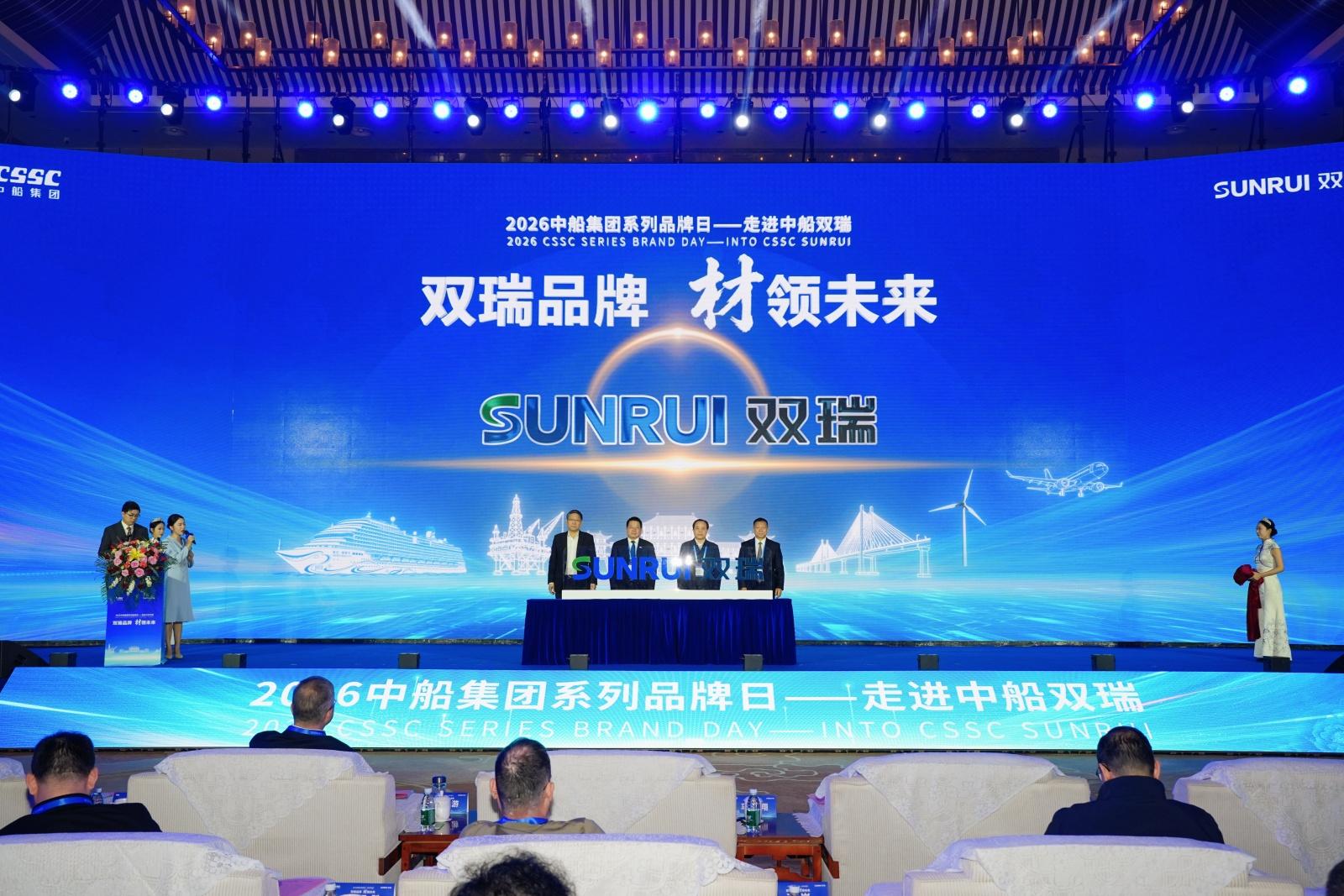
On November 13, the 2026 CSIC Series Brand Day event "Entering CSIC SunRui" was held in Luoyang, Henan Province. The event, themed "CSIC Materials, SunRui Brand," was hosted by China State Shipbuilding Corporation Limited and organized by the China Shipbuilding Industry Corporation 725 Research Institute. More than 200 representatives from government departments, industry associations, research institutes, and sectors such as shipbuilding, marine engineering, aerospace, clean energy, petrochemicals, and nuclear power equipment gathered in Luoyang for in-depth discussions on independent innovation in high-end materials and collaborative innovation in the industrial chain.
The SunRui brand was born from decades of experience at the 725 Institute in developing ship materials, carrying the mission of transitioning from national key projects to the forefront of the national economy. This brand day event is not only the launch moment for the new SunRui logo but also a platform to showcase the "material capabilities" to the industry.
New Logo Released, SunRui Brand Value Reaches 8.444 Billion Yuan
During the event, the new SunRui logo was officially unveiled. The new logo features "SUNRUI" as the main image, incorporating wave curves into the initial "S" to symbolize resource sharing and mutual benefits between clients and industrial chain partners. The overall design adopts green and blue tones to align with the direction of green and low-carbon development, with blue representing the marine industry landscape. It reflects SunRui’s vast vision spanning across oceans and its deep commitment to transnational maritime engineering and marine resource development.
The 725 Institute, established in 1961, is a research institution in the national defense system that focuses on the development and engineering application of ship materials. It is also the overall ship material unit of CSIC. In 1998, the 725 Institute first proposed the "SunRui" civilian brand, gradually developing an industrial landscape covering special equipment, titanium and titanium alloys, corrosion control and water treatment, and rubber and plastic composite materials.
At the 2026 China Brand Value Evaluation Information Release Conference, the "SunRui" brand achieved a value of 8.444 billion yuan and a brand strength of 945, marking ten consecutive years of steady growth. Previously, SunRui had earned honors such as the “China Famous Trademark,” the "Most Competitive Brand" by the Ministry of Commerce, and was ranked among the top ten manufacturing brands in Henan Province. CSIC SunRui will focus on three main strategies: "building the brand on quality, strengthening the brand through technology, and promoting the brand through innovation," driving the development of the brand from being a top domestic materials brand to becoming a globally competitive Chinese materials brand.
Six Technical Reports Highlight Achievements in Localization Substitution
This event featured six technical reports covering topics such as titanium and titanium alloys, non-metal composite materials, integrated corrosion and antifouling, high-efficiency fluid heat exchange equipment, wind-assisted ship propulsion, and additive repair of equipment components. These reports systematically showcased CSIC SunRui's entire industrial chain capabilities, from materials to processes, equipment, and industry.
In the field of titanium and titanium alloy, the 725 Institute began tackling marine titanium alloy challenges in the 1960s, establishing a complete industrial chain for sponge titanium, ingot billets, precision strips, complex castings, titanium alloy pipelines, and equipment. SunRui Wanji Titanium Industry provides a stable supply of high-end sponge titanium with an electronic-grade purity of 99.995%. SunRui Precision Casting has repeatedly broken reliance on imports in the field of large thin-walled titanium alloy components, with its products applied in ship pressure hulls, commercial aerospace main load-bearing components, medical implants, and other scenarios. In welding, the institute has developed a cluster of technologies including arc welding, laser welding, electron beam welding, and friction stir welding, supporting the manufacturing of equipment for demanding applications such as ships, nuclear power, and petrochemicals.
The non-metal composite materials section showcased marine composite laminated blocks, fire-resistant grilles, carbon fiber fabrics with accompanying resins, and modular penetrable sealing systems. Specifically, the composite laminate block replaces traditional wooden laminate wood, reducing supply cycles from 12-18 months to less than a month. It has obtained certification from eight major classification societies, including ABS, DNV, BV, LR, and CCS, and has entered the supply chains of shipowners such as Maersk, Mediterranean Shipping, and COSCO. Fire-resistant grilles meet USCGL2 fire resistance requirements and have an annual production capacity of 600,000 square meters. Carbon fiber fabrics and resins achieved full domestic substitution in upper structures of small ships and electric propulsion vessels.
The corrosion and antifouling section proposed an integrated solution of "coating + cathodic protection + MGPS." Relying on the nation’s only National Key Laboratory for Marine Corrosion and Protection, the 725 Institute developed systematic techniques for critical parts like ship ballast tanks, submerged hull areas, and underwater doors with antifouling requirements. The technologies—including anticorrosion coatings, antifouling coatings, sacrificial anodes, and impressed current systems—cover various ship types. These technologies have been deployed in projects such as the Shenzhen-Zhongshan Bridge, Donghai Bridge, and multiple FPSO models, where FPSO cathodic protection solutions hold a leading international market share.
Fluid heat exchange equipment was another highlight of the reports. CSIC SunRui developed the printed circuit board-type microchannel heat exchanger (PCHE), which can withstand temperatures ranging from -253℃ to 900℃ and pressures exceeding 100 MPa. It has been applied in fourth-generation nuclear reactors, LNG regasification systems, and supercritical CO2 power-generation pilot plants. The LNG open-rack vaporizer (ORV) broke the long-standing foreign monopoly and has achieved the top supply record for domestic coastal receiving terminals. Specialized valves, automatic backwash filters, and detachable plate heat exchangers were simultaneously developed for various scenarios in marine, petrochemical, and heating industries.
The ship wind-assisted propulsion system became a focal point of attention at the event. Starting with rotor sails, CSIC SunRui has developed a range of products from Φ4×24 to Φ5×35. The land-based prototype’s maximum thrust is 355 kN, with an actual fuel savings rate of approximately 5% to 25% for vessels. These products have received certification from ABS, BV, CCS, and DNV classification societies, with orders spanning VLCCs, VLOCs, bulk carriers, and other mainstream ship types. Wing sails and suction sails have also undergone prototype testing, showcasing their capability for multi-sail hybrid configurations.
The additive repair section showcased results such as onboard component remanufacturing, underwater localized dry welding, and metal/non-metal 3D printing equipment. During shipboard maintenance in 2024–2025, the CSIC SunRui team conducted multiple batches of component arc additive manufacturing and repairs. Underwater additive repair robots can address external hull collision and corrosion damage without docking, providing innovative solutions for emergency ship maintenance.
Exploring Industrial Bases, Comprehensive Capabilities Demonstrated
During the event, participants were divided into groups to visit the main campus of the 725 Institute and the SunRui industrial base. They examined the National Key Laboratory for Marine Corrosion and Protection testing platform, titanium alloy precision manufacturing production line, composite materials workshop, fluid heat exchange equipment assembly line, and additive manufacturing equipment demonstration area.
The 725 Institute is headquartered in Luoyang and has research centers and industrial bases in Qingdao, Xiamen, Sanya, Shanghai, Beijing, Dalian, Hami, and other locations, as well as overseas service outlets in countries such as Japan, Singapore, and Germany. From material formulations and pilot-scale verification to mass industrialization, the visit route offered an intuitive demonstration of the closed-loop capabilities encompassing “research tasks – engineering transformation – market supply.”
Several representatives from shipyards and energy companies expressed that SunRui has established comprehensive and integrated capabilities in products like titanium piping systems, anticorrosion coatings, heat exchangers, and sails, which are instrumental in reducing dependence on imports and shortening construction cycles.
Six Types of On-Site Project Signing, Industrial Chain Collaboration Implementation
During the meeting, a project signing ceremony was held, covering six areas: marine coatings, aerospace materials support, nuclear power components, petrochemical anticorrosion equipment, high-efficiency fluid heat exchange products, and wind-assisted propulsion systems. Multiple shipowners, shipyards, and energy companies partnered with the 725 Institute and SunRui enterprises, transforming technical reports into specific orders and cooperation mechanisms.
According to disclosures at the event, signed projects included practical ship application orders such as paint support for five 109,000-ton crude oil ships, as well as cross-industry collaborative projects like nuclear power heat exchangers, petrochemical cathodic protection, and wind power composite structural components. The 725 Institute stated that it will use the projects as leverage, collaborating with upstream and downstream enterprises to conduct material customization, process assessment, on-site services, and standards formulation, forming an integrated model of “research – supply – service.”
From Material Independence to Equipment Independence
The growth path of the 725 Institute serves as a model for a central enterprise transitioning from being a ship material authority to a pillar of the national economy. From a single titanium plate, a coating layer, and a heat exchanger to an entire wind-assisted propulsion system, the unified characteristic of SunRui’s products is "independent materials + engineering validation + industrial transformation."
Looking ahead to the "15th Five-Year Plan," the 725 Institute plans to further strengthen its focus on tackling key core technologies and expanding the application boundaries of the SunRui brand in areas such as marine engineering, wind power, nuclear energy, hydrogen energy, and infrastructure equipment. At the same time, it aims to enhance its global service network by leveraging industrial platforms such as SunRui Environment, Xiamen SunRui, SunRui Special Equipment, SunRui Wanji Titanium, SunRui Precision Casting, and SunRui Rubber and Plastic.
"Without strong materials, it’s hard to achieve strong equipment; material self-reliance is the key to industrial self-sufficiency," said Li Ka, Director and Party Secretary of the 725 Institute, in his concluding remarks. He emphasized that CSIC SunRui would take this brand day as a new starting point to continuously transform research capabilities into competitive high-end civilian products. By supporting national equipment with reliable materials, the institute aims to contribute to the high-quality development of the manufacturing industry.
-
The 2026 CSSC Series Brand Day "Visit to CSSC Sunrui" event was held in Luoyang.4048
-
The second domestically-built large cruise ship “AIDA Flower City” completes its first trial voyage.3203
-
The 'Huayuan 668' shipwreck salvage was successful, clearing a navigational obstacle that lasted twelve years.3086
-
Cold wave and low water levels overlap, ensuring uninterrupted transportation of essential goods in the Jiangyin section of the Yangtze River.3160
-
Passing on craftsmanship and shouldering the mission! "People's Craftsman" Xu Zhenchao visits the Yantai Salvage Bureau to promote the spirit of craftsmanship.4340