The authoritative report! China's shipping industry ranked second
Recently, the China Academy of Information and Communications Technology officially released the "Manufacturing Digital Transformation Development Report (2025)" (referred to as the report). The report shows that as of December 2025, the digital transformation of key industries in China has formed a tiered differentiation pattern. Among them, the proportion of enterprises in the shipbuilding industry undergoing digital transformation reached 94.2%, ranking second among the 14 key industries implementing digital transformation in China.
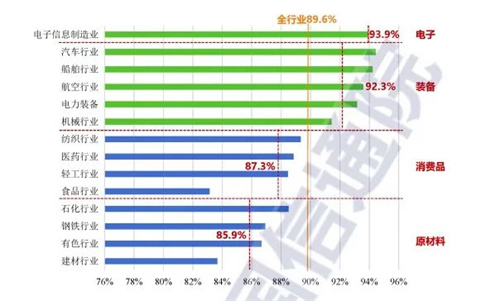
Digital transformation coverage rate of 14 key industries / Source: "Manufacturing Digital Transformation Development Report (2025)"
The report states that currently, the breadth of digital transformation in China's manufacturing industry has significantly improved and has entered the stage of large-scale popularization. As of December 2025, the proportion of large-scale industrial enterprises nationwide undergoing digital transformation reached 89.6%, and the penetration rate of digital equipment reached 57.7%. At present, the Ministry of Industry and Information Technology, in conjunction with relevant ministries, has issued digital transformation implementation plans for 14 industries, including steel, non-ferrous metals, petrochemicals, building materials, machinery, aviation, shipbuilding, power equipment, light industry, food, textiles, pharmaceuticals, automobiles, and electronic information manufacturing. These plans clarify the transformation goals for each industry and implement precise digital transformation with a "one industry, one policy" approach.
According to the report, the shipbuilding industry, focusing on the needs of complex system engineering, has achieved integrated design and construction as well as full lifecycle management. Shipbuilding involves hundreds of thousands of components, requiring cross-disciplinary collaboration and long construction cycles, making overall control challenging. The key to its digital transformation is to build a digital collaboration system that spans the entire chain of "design—delivery—operation." Data shows that the "marketing and service" segment of the shipbuilding industry scores relatively high, and the "R&D and design" segment scores above the average level of the manufacturing industry. This includes empowering R&D and design with data and models to achieve efficient multi-disciplinary collaboration, enhancing supply chain collaborative response capabilities through refined control of intermediate products, and extending the service value chain by relying on ship management systems to promote a business model upgrade from "ship delivery" to "operation services."
The report shows that China's shipbuilding industry has achieved "paperless" construction based on a single data source. By building comprehensive 3D digital models, it drives steel plate cutting, piping processing, and on-site assembly, completely eliminating 2D drawings and eradicating "errors, omissions, collisions, and deficiencies" between structures, outfitting, and piping from the source, achieving integrated design and construction. For example, Jiangnan Shipyard (Group) Co., Ltd., a subsidiary of China State Shipbuilding Corporation Limited, utilized the "3D Experience Platform" to achieve deep integration of design and construction when building advanced ship types.
At the same time, China's shipbuilding industry has also achieved refined logistics control of intermediate products. Addressing the characteristics of long construction cycles and multiple storage yards in shipbuilding, industrial internet technology is used to sense the real-time transfer status of massive intermediate products across storage yards, painting, and final assembly stages. This enables factory-style final assembly based on precise rhythms, solving the problems of logistics blockages and resource idleness in large-scale discrete engineering. For instance, Nantong COSCO KHI Ship Engineering Co., Ltd. uses a self-developed logistics control system to manage each pallet with barcode/RFID identification, ensuring that materials are delivered to the correct workstation at the right time (JIT) and in the correct quantity.
In addition, some enterprises have applied ship management systems oriented toward asset operations. For example, China Merchants Energy Shipping Co., Ltd. relies on the "Intelligent Ship Operation Support Platform" to analyze real-time data on weather, sea conditions, speed, and energy consumption transmitted back by ocean-going ships. This provides captains with "optimal route suggestions" and "optimal trim optimization," helping shipowners reduce operating costs and meet carbon emission requirements.
The report points out that digitalization accelerates pilot testing and collaborative innovation, becoming an important pathway to shorten the industrialization of scientific and technological achievements. In the future, digitalization will further break down "barriers" between enterprises and processes, enabling the flow of R&D data, process models, and verification results across the upstream and downstream of the industrial chain. This will form a model of "joint R&D—collaborative verification—co-iteration." For example, companies like COMAC and China State Shipbuilding Corporation collaborate with research institutions and supporting enterprises through open digital R&D platforms to conduct collaborative design and pilot testing, achieving "one pilot test, multiple beneficiaries," accelerating the maturity of key technologies, and enhancing the collaborative innovation capability of the industrial chain.
-
The Three Gorges hub's river section experiences thriving passenger and cargo traffic during the National Day holiday.3732
-
Guangdong and Hainan departments cooperate to patrol Qiongzhou Strait, building a strong line of defense for maritime travel safety.3797
-
Zhoushan Maritime Implements Multiple Measures to Ensure the Safety of Passenger Ferry Operations4719
-
The first provincial-level crew industry party committee in northern China has been established in Tianjin.4324
-
Taicang Port to Chancay Port frame container shipping mode achieves regular operation4250