
-
 Since 2021, Chongqing has achieved remarkable results in the protection and restoration of the Yangtze River. Through the implementation of the "zero discharge" treatment mode of "storage on board and disposal on shore" of ship sewage, the illegal discharge of ships in Chongqing section of the Yangtze River has been reduced by 90%, the cost of pollution prevention and control by enterprises has been reduced by 70%, and the cumulative reduction of sewage has exceeded 1 million tons. Through the transformation of ship facilities, the construction of receiving facilities, the joint supervision mechanism and the guarantee of local legislation, the model realizes the integrated supervision of trunk and tributary and the closed-loop management of the whole process, providing a model experience for the governance of the Yangtze River.
-
On February 28, the Ministry of Transport held a ministerial meeting to convey the spirit of learning from the central government and deploy key tasks. The meeting considered documents such as the construction of a modern navigation security system, the implementation plan for the convenient passage of highways without cards, and the guidelines for accounting for the carbon footprint of transportation. The meeting emphasized the need for high-quality preparation of the "Tenth Five-Year Plan", to ensure transportation during the Spring Festival and the National Two Sessions, to prevent safety risks, and to promote the industry's green and low-carbon transformation and high-quality development.
-
After the attack on Iran by the United States and Israel, Iran announced the closure of the Strait of Hormuz, causing many international shipping companies to suspend passage through the Strait. This key waterway is responsible for about 1/5 of the world's oil transportation and a large amount of liquefied natural gas exports, and its closure has caused multinational ships to be stranded or diverted. The German Shipowners' Association said the maritime industry is experiencing an "acute operational crisis", with the industry facing severe challenges of route disruptions, delays and increased safety risks.
-
The article reported the strong opening momentum of China-Europe Express (Fuzhou) in 2026. Since the beginning of this year, four trains have been opened, with the value of goods exceeding 66 million yuan. The goods carried include baby diapers, clothing and other livelihood products, as well as high value-added products such as CNC machine tools and generator sets. The leap from "small commodities going to sea" to "high-value connectivity" has helped "China's intelligent manufacturing" to go to the world and share the vitality of China's development.
-
The "Development Report on Digital Transformation of Manufacturing Industry (2025)" released by the China Academy of Information and Communications Technology shows that the digital transformation of my country's manufacturing industry has entered the stage of large-scale popularization, and the proportion of digital transformation of industrial enterprises above regulations has reached 89.6. The shipbuilding industry performed well, with the proportion of digital transformation enterprises reaching 94.2 percent, ranking second among 14 key industries. The report points out that the shipbuilding industry has realized "paperless" construction, fine control of segmented logistics and extension of operation services by building a digital collaborative system of design and construction integration and full life cycle management, effectively improving the efficiency and innovation ability of the industry.
-
The Financial Secretary of the Hong Kong Special Administrative Region Government, Chen Maobo, predicted in the 2026/2027 budget that Hong Kong's economy will grow by 2.5 to 3.5 in 2026. He said that the stable development of the mainland economy, the expansion of trade driven by new technology investment such as AI, the steady growth of domestic demand, and the stability of the labor market will jointly support the Hong Kong economy. At the same time, the underlying inflation rate is expected to be 1.7 per cent and the headline inflation rate is 1.8 per cent. The medium-term outlook shows economic growth averaging 3 per cent per annum in real terms between 2027 and 2030.
-
During the Spring Festival in 2026, the number of passengers sent by the "mini three links" passenger routes between the two sides of the strait reached 47000, an increase of 33.14 percent over the same period last year, showing a significant growth trend. Fujian coastal waterway passenger transport sent 2.2767 million passengers as a whole, an increase of 17.57 percent over the same period last year, of which the passenger flow of Meizhou Island, Lujiang night tour and other routes increased significantly. Fujian Maritime Safety Administration has ensured the safety of water traffic during holidays without accidents by strengthening dispatching and risk control.
-
 On the afternoon of February 11, the "Industrial Belt Cross-Border: IBI and Multinational Envoys High-End Business Exchange Meeting" was successfully held at the IBI Digital Economy Headquarters. Attendees included His Excellency Dario Mihelin, Ambassador of Croatia to China; His Excellency Luamanuvae Albert Mariner, Ambassador of Samoa to China; His Excellency Tresor Irambona, Ambassador of Burundi to China; His Excellency Sinisa Berjan, Ambassador Extraordinary and Plenipotentiary of Bosnia and Herzegovina to China; His Excellency Baada Kaladze, Ambassador of Georgia to China; Mr. Novruz Ceta, Minister-Counselor of the Embassy of Albania in China; and Ms. Sabita Nakarmi, Commercial Counselor of the Embassy of Nepal in China, among others.
-
 On February 6th, the first member assembly of the Beijing Future Entrepreneurs Promotion Association was officially held. Leaders from the Beijing Federation of Industry and Commerce, Fengtai District, and nearly a hundred member representatives gathered to witness this grand event aimed at promoting high-quality regional economic development. The Beijing Future Entrepreneurs Promotion Association adheres to the core philosophy of "entrepreneurship guided by the Party, innovation for the nation, and contribution to the people." With the mission of "uniting the strength of future entrepreneurs and promoting the development of new productive forces," the association strives to build a multi-level, precise service system to assist member enterprises in achieving technological innovation, industrial upgrading, and high-quality development, aiming to become a domestic leader and an internationally influential platform for future entrepreneurs.
-
 Recently, IBI founder and CEO Qian Xiaojun attended the Fengtai Two Sessions' special program "Dialogue with Leaders" and the 2026 Fengtai Conference on High-Quality Development of Private Economy. He discussed the implementation of the regional "15th Five-Year Plan" and the innovative development of the private economy, systematically conveying the practical paths and responsibilities of enterprises in deepening industrial digitization and assisting regional upgrades. As a guest on the Fengtai Two Sessions' "Dialogue with Leaders," Qian Xiaojun, representing key enterprises, engaged in dialogue with guests such as Lu Yingbo, Director of the Fengtai District Development and Reform Commission. He stated that IBI, during the "14th Five-Year Plan"...
-
 Ye Niuping meets with IBI CEO Qian Xiaojun On January 20, Mayor Ye Niuping met with Qian Xiaojun, founder and CEO of Beijing IBI Video Information Technology Co., Ltd., and his delegation. Both parties expressed their intention to leverage Xi'an's advantages in abundant scientific and educational resources, a complete industrial system, and strong innovation capabilities. They aim to actively utilize IBI's excellent operational model and rich platform resources in industrial e-commerce, digital supply chains, and industrial big data to deepen data empowerment, strengthen industrial collaboration, and promote the deep integration of technological innovation and industrial innovation. They will continue to enhance the development of the digital economy, industrial digital transformation, and cross-border commodity transactions.
-
 To thoroughly implement the national "Belt and Road" initiative and actively respond to the call for coordinated development of cross-border industrial and supply chains, the FDD platform under IBI, with industrial internet as its core link, continues to expand its global business layout and deepen international agricultural and industrial ecological cooperation. Recently, a delegation led by IBI Vice President and FDD CEO Yin Haifeng, FDD Singapore E-commerce Co., Ltd. General Manager Wang Qing, and FDD Cross-border Business Department Director Zhang Yi visited Sri Lanka for a multi-day business visit. The delegation engaged with local government departments, key institutions, and leading enterprises, focusing on agricultural modernization and cross-border supply chain construction.
-
 On January 23, Chairman Fan Xingmin and Deputy Secretary-General Zhang Yanjie of the China National Defense Science and Technology Industry Cultural Exchange Association visited the IBI Digital Economy Headquarters for a work survey. They were warmly received by Chen Can, Vice President of IBI and Senior Vice President of IBI Resource Network. The visiting delegation first toured the IBI Digital Economy Exhibition Hall to gain a detailed understanding of IBI's achievements in industrial e-commerce, industrial digitalization, and cross-border industrial zones. Chen Can highlighted the company's practical experience in promoting the integration of digital technology with the real economy, especially in the exploration of cultural empowerment and industrial linkage. During the subsequent discussion, both parties...
-
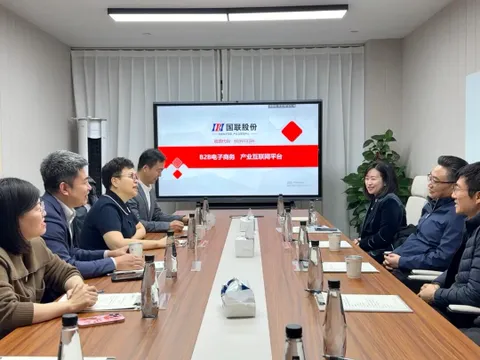 The delegation led by Shi Zhongjun, the Secretary-General of the China-ASEAN Center, visited IBITDD.On January 15, the delegation led by Shi Zhongjun, the Secretary-General of the China-ASEAN Center, visited IBI and engaged in discussions with Liu Zhai, IBI board member and Senior Vice President, among others. Shao Zhaojun, IBI Vice President and TDD Senior Vice President, accompanied them throughout the visit. Both parties engaged in in-depth discussions on topics such as the strategic layout of the Guangxi and ASEAN markets, B2B platform development, and the advancement of regional headquarters construction, jointly exploring new paths for digitally upgrading economic and trade cooperation between China and ASEAN countries. The visiting delegation also toured the digital economy exhibition hall, gaining insights into IBI's current operational model of the Duoduo platform, cross-border operational strategies for industrial belts, and the application and practice strategies of the IBI Cloud.